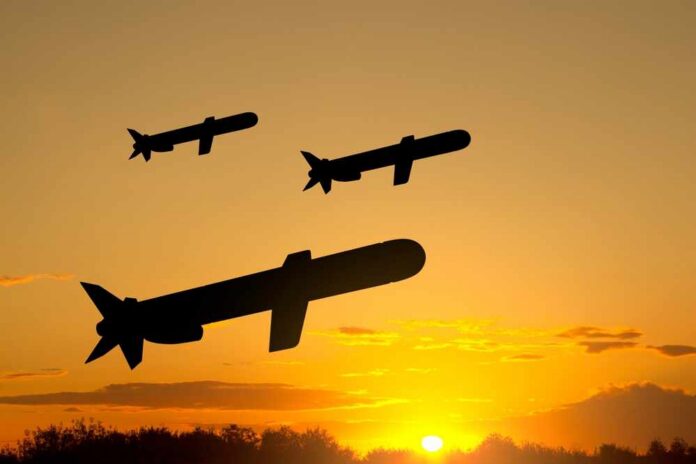
The Tomahawk Block IV’s real superpower isn’t hype—it’s the ability to strike far, stay flexible, and change targets mid-mission without putting American pilots in the line of fire.
Quick Take
- The “Tomahawk Block IV makes America a superpower” claim is overstated, but the missile is a proven tool of U.S. power projection and deterrence.
- Block IV’s two-way satellite data link enables in-flight retargeting, loitering, and battle damage assessment—features designed for fast-moving modern conflicts.
- U.S. Navy ships and submarines can launch long-range strikes from standoff distances, reducing risk to U.S. forces while maintaining pressure on adversaries.
- From 2021 through 2026, Pentagon focus has shifted toward Block V upgrades—service-life extension plus maritime strike and new warhead options.
Why Block IV Matters: Reach, Precision, and Command Flexibility
The Tomahawk program dates back to the 1970s and entered service in 1983, built for long-range, subsonic strikes that can be launched from U.S. Navy platforms. Block IV, introduced in the mid-2000s, pushed the missile from “preplanned strike” to “commander’s weapon,” emphasizing tactical flexibility. Public technical reporting credits the Block IV with a two-way satellite data link, enabling mission updates after launch and supporting more dynamic operations.
Block IV’s most discussed features are loiter capability and in-flight retargeting—capabilities that matter when intelligence changes after launch, targets relocate, or commanders need to pause and reassess. Defense reporting also highlights battle damage assessment enabled by onboard sensors and communications, giving commanders feedback without immediately risking manned aircraft. Range figures vary by source and variant, but multiple references converge on roughly 900 nautical miles for the Block IV class, keeping launch platforms farther from danger.
Combat Track Record: A Workhorse, Not a Magic Wand
Combat history is where the Tomahawk earns its reputation, and the record is long: Gulf War strikes in 1991, follow-on operations in the Balkans, and extensive use across Iraq and Afghanistan. Public reporting commonly describes roughly 2,000 Tomahawks used in combat over decades, with later versions achieving high precision. Those facts support a serious conclusion: the system has been tested repeatedly, works at scale, and fits how America fights when leaders want standoff effects instead of occupation.
That said, the “this missile makes America a superpower” framing doesn’t match the evidence. The research summary itself flags the phrase as hyperbolic and not tied to a single originating event or official claim. Superpower status comes from a broader stack: nuclear deterrent, intelligence networks, industrial base, global logistics, carrier aviation, and alliances. What the Block IV demonstrably does is help translate those advantages into credible, fast military options—without the open-ended costs voters associate with nation-building.
Block V Upgrades: Extending Life and Adding Maritime Strike
From 2021 through 2026, the storyline shifts from “Block IV dominance” to “Block IV becoming Block V.” Public sources describe recertification and service-life extension efforts, plus enhanced navigation and communications. A major operational change is the push for a maritime strike variant (often described as Block Va) designed to engage moving ships, which demands improved seekers and networked targeting. Another line of effort adds different warhead effects (often described as Block Vb).
Raytheon remains the prime contractor associated with production and upgrades, while the U.S. Navy remains the main operator via its Tomahawk command-and-control architecture. That contractor-operator relationship matters for taxpayers and oversight because modernization choices are measured in long-term programs and budgets, not flashy headlines. The research points to billions in defense-industry activity tied to sustaining inventory and upgrading older rounds, reinforcing the need for Congress to demand performance, readiness, and cost discipline.
What This Means Under Trump: Deterrence Without Endless Wars
For Americans who watched the last decade’s inflation and fiscal churn, the appeal of standoff capability is straightforward: credible deterrence that reduces pressure for large deployments. A cruise missile is not a strategy, but it is a tool that can buy options—especially when launched from ships and submarines that already patrol key regions. The more flexible the weapon, the less likely commanders are forced into “use it or lose it” choices based on outdated targeting.
The hard limitation is that the public sources summarized here don’t support the claim that Block IV alone “makes” the United States a superpower. The more defensible takeaway is narrower and more factual: Block IV—and its transition into Block V—helps the U.S. project power quickly, at range, with precision and adaptability, while reducing risk to U.S. service members. In an era when voters demand competence, restraint, and constitutional seriousness, that kind of capability is influential—even if it isn’t the whole story.
Sources:
Tomahawk Long Range Cruise Missile
Royal Navy submarine test-fires Block IV Tactical Tomahawk