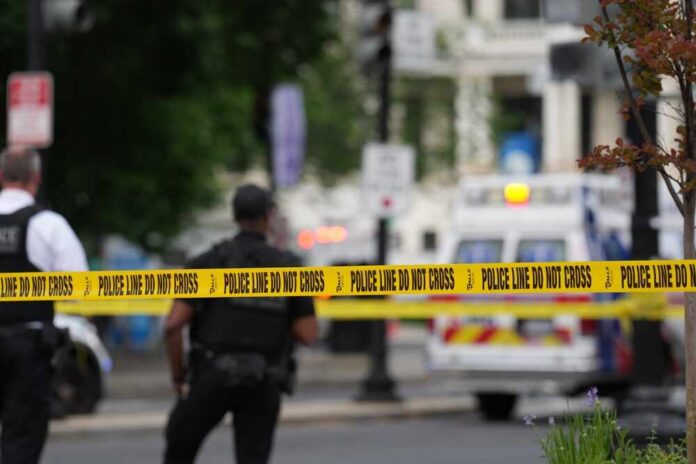
Eight children dead in one pre-dawn rampage is the kind of domestic horror that forces Americans to ask why government systems keep missing the most dangerous warning signs.
Story Snapshot
- Shreveport police say an adult male shot 10 people across two homes early Sunday, killing eight children ages 1–14 and seriously wounding two women.
- Investigators described the incident as a domestic disturbance that escalated into a mass killing rather than a random public attack.
- Police say the suspect carjacked a vehicle at gunpoint, fled, and was killed during a chase.
- Victims’ identities were not immediately released as the coroner’s office worked through next-of-kin notification.
What happened in Shreveport, and what police have confirmed so far
Shreveport, Louisiana, became the scene of the deadliest U.S. mass shooting in more than two years after an adult male killed eight children—seven reported to be his own—and wounded two women, according to police and early reports. Authorities said the shootings unfolded before sunrise Sunday, April 19, across two homes south of downtown. Officers later confronted the suspect after a pursuit, and he died at the scene.
Police accounts indicate the suspect first shot a woman at one residence, then drove to a second home where most of the children were killed. A police spokesperson said one child ended up on a roof after attempting to escape, underscoring the chaos inside the home as the attack unfolded. Authorities said a total of 10 people were shot, with the two adult women hospitalized in serious condition.
A domestic dispute turned mass killing, not a random attack
Officials framed the episode as domestic violence that exploded into a familicide-style mass shooting, which matters for how communities prevent future tragedies. When violence is rooted in an intimate or family relationship, the danger often concentrates behind closed doors rather than in public venues with obvious security. The local district attorney’s office said what began as a domestic dispute ended in “irreversible harm,” while police emphasized the incident’s domestic nature.
Key details remain unclear, including the motive and the relationship of the “one other child” who was killed alongside the suspect’s seven children. Neighbors described seeing the man with the children days earlier, which adds to the public shock: outward normalcy can coexist with private instability. The coroner’s office withheld names as identification and notification procedures continued, a standard step that also limits outside speculation in the immediate aftermath.
Flight, carjacking, and the police pursuit that ended the threat
After the shootings, police said the suspect carjacked a vehicle at gunpoint and fled, triggering a chase that ended with officers firing on him. The suspect died at the scene, and authorities indicated he was the sole shooter, with no additional arrests announced. That outcome ends any potential prosecution but does not end the investigative work, which must still reconstruct the timeline, secure evidence from both homes, and document the suspect’s movements.
Why this story hits a nerve in 2026: safety, government competence, and trust
National politics tends to lurch toward familiar talking points after major shootings, but this case does not fit neatly into the standard “public place” template. A domestic disturbance that turns into a mass casualty event raises uncomfortable questions about whether institutions meant to protect the vulnerable—local law enforcement, courts, and social services—have the tools and coordination needed to identify imminent family threats. The available reporting does not show prior incidents tied to this family, limiting conclusions about missed interventions.
For conservatives who already distrust sprawling bureaucracies, the core issue is competence: citizens expect government to do the basics well—public safety, clear communication, and rapid accountability—before lecturing communities about broader social agendas. For liberals focused on social welfare and equity, the same facts fuel arguments for more intervention and support structures. Either way, the public sees the same failure point when a private dispute produces eight dead children.
"Louisiana gunman killed seven of his own children and one other child in deadliest US mass shooting in years, police say
The suspect has been identified by police as Shamar Elkins"
The Independent https://t.co/lCBBGtKz1n pic.twitter.com/IgEdQX6VwO
— Ronni Nicole #KPSS (@RonniNicole1) April 20, 2026
Policy debates will likely follow, but the strongest immediate takeaway is narrower and more practical: domestic violence can be a mass-casualty threat, and the people trapped inside those homes have little chance once it begins. With victims so young and details still emerging, responsible observers should avoid filling gaps with assumptions. The investigation, coroner identification process, and medical updates on the wounded women will determine what the public can responsibly conclude next.
Sources:
8 children between the ages of 1 and 14 are dead after a mass shooting in Louisiana, police say.