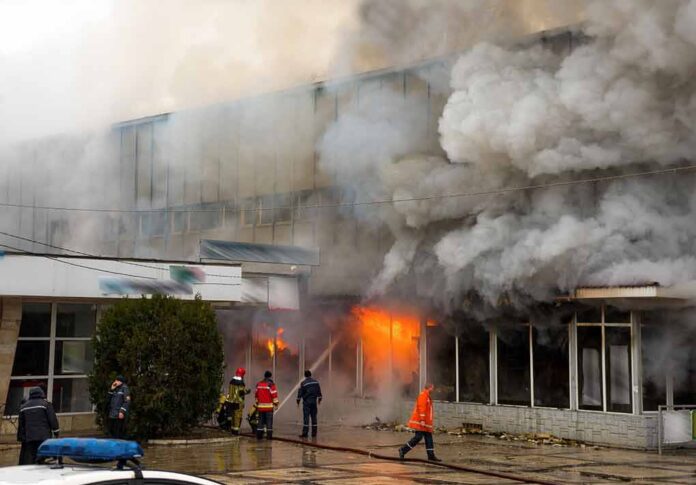
A deadly chemical tank implosion in Washington state raises urgent safety and transparency questions that regulators must answer — now.
Story Snapshot
- Officials confirm one worker dead, nine missing, with multiple injuries at a Longview paper mill [1].
- Authorities say the cause remains undetermined and the tank site is unstable, complicating recovery [1][2].
- Responders identify “white liquor,” a highly caustic mix, as the involved chemical, heightening on-site hazards [1][2].
- Leaders state there is no immediate public threat while investigations proceed and families are notified [1][2].
Confirmed Casualties And Hazardous Conditions At The Longview Mill
Officials in Longview, Washington reported one confirmed death and nine unaccounted-for workers after a chemical tank implosion at a pulp and paper mill, with additional workers and one firefighter injured during the response [1]. Authorities documented the incident Tuesday morning around 7:15 to 7:19 a.m., triggering a large-scale emergency operation [1][2]. Fire officials described the scene as dangerous, citing an unstable tank that required stabilization before deeper recovery efforts could continue, underscoring the risks to responders on site [1][2].
Responders identified the involved substance as “white liquor,” a caustic mixture that includes sodium hydroxide and sodium sulfide, increasing the risk of chemical burns and complicating entry and rescue decisions [1][2]. Officials emphasized that their immediate priorities were accountability of personnel, hazard control, and stabilization of the structure to prevent secondary failures [2]. Leaders said family notifications remained ongoing and that identifying information would be withheld until next of kin were reached, reflecting an active and evolving accountability process [2].
Cause Unknown, Public Threat Assessed As Limited — For Now
Authorities stated that the cause of the tank implosion remains undetermined and under investigation, and no agency has released engineering or forensic findings explaining the failure mechanism [1][2]. Officials also reported no immediate threat to the surrounding community, a judgment offered while crews managed stabilization and chemical hazards at the site [1][2]. Without air-monitoring data, plume modeling, or a written environmental assessment in public view, that reassurance stands as an operational assessment rather than a published technical proof [1][2].
Conflicting early counts across broadcasts — including references to fatalities and totals of injured — further highlight how major industrial incidents often present fluid numbers during rescue and notification phases [1][2]. The record to date is dominated by rapid news coverage and press briefings, not yet by released dispatch logs, incident action plans, or safety compliance documents. Until those materials are public, the casualty accounting and causation picture will remain incomplete and subject to revision based on primary-source evidence [1][2].
Accountability Questions And Records The Public Should See Next
Investigators will need to determine whether corrosion, overpressure, metal fatigue, or procedural error contributed to the implosion, and whether the operator’s inspections, alarms, and maintenance met required standards. Public confidence depends on transparent release of incident command timelines, Washington Department of Labor and Industries investigative notes, environmental sampling, and any safety citations resulting from the review. Those records can confirm whether early “no immediate public threat” statements align with measured data and whether workplace protections were adequate [1][2].
At least 1 dead, 9 others missing in chemical tank implosion at Washington state pulp and paper mill https://t.co/f5FzlWobdD
— ABC11 EyewitnessNews (@ABC11_WTVD) May 27, 2026
Conservative readers value straight facts and clear accountability. Families deserve timely answers, workers deserve safe conditions, and communities deserve honest risk communication. The Trump administration’s charge is limited, effective government that enforces safety without political theater. That requires rapid disclosure of on-the-record findings, not just podium statements. Release the logs, the sampling, and the inspection history. If protocols were followed, prove it. If they were not, fix it and hold the right people responsible — quickly and publicly [1][2].
Sources:
[1] Web – Chemical tank implosion in Washington state kills one worker and …
[2] Web – At least 1 dead, 9 workers missing after chemical tank implosion at …