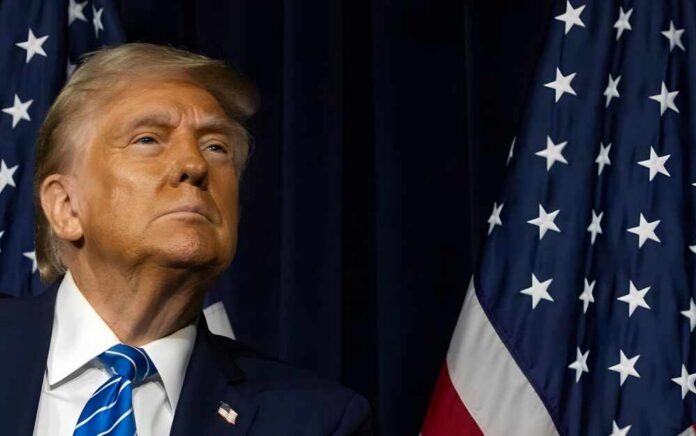
When a sitting president jokes that both parties want a senator “the hell out” and hints at sending him to the Supreme Court, it exposes just how broken Washington’s power games have become.
Story Snapshot
- President Trump again floated Senator Ted Cruz as a possible Supreme Court justice, saying he’d get “100%” support because senators want him out of Congress.
- Ted Cruz has repeatedly and emphatically said he does not want the job, describing his answer as “not just no, but hell no.”
- The episode shows both parties using the Supreme Court as a political pressure valve, not just a place for neutral judges.
- Voters across the spectrum see this as more proof that the “elite” class plays musical chairs with power while real problems go unsolved.
Trump’s Cruz Supreme Court Talk: Joke, Trial Balloon, or Warning Sign?
At a Washington event promoting new “Trump Accounts” for children, President Donald Trump suddenly shifted from policy to politics and brought up Senator Ted Cruz as a possible Supreme Court pick. Trump praised Cruz as “a very tough guy” with a “brilliant legal mind” and then said if he nominated Cruz, he would get “100% of the vote” in the Senate. He claimed Democrats and Republicans alike would back Cruz simply to “get him the hell out” of the Senate, drawing laughs from the crowd while Cruz sat just feet away.
This was not the first time Trump floated Cruz for the high court, and not the first time he framed it as half joke, half serious trial balloon. Back in 2020, Trump publicly added Cruz to a list of about 20 possible Supreme Court nominees, saying Cruz could win both 50 Republican and 50 Democratic votes and calling him part of the “best minds in the country” who “believe in the Constitution.” Trump repeated similar lines at a rally in Corpus Christi, Texas, saying Cruz is “such a pain” but “so good and so talented,” again suggesting Cruz’s legal skills and political unpopularity make him a unique kind of candidate.
Cruz’s “Hell No” and Why He Says He Won’t Take the Job
Senator Ted Cruz has answered these ideas with something close to a shout: he does not want to be a Supreme Court justice. In interviews and statements, Cruz has said that during Trump’s first term the president talked to him seriously about all three Supreme Court vacancies, and each time Cruz said no. He explained that a “principled federal judge” must stay out of direct policy fights and political battles, and that is exactly what he does not want to do. Cruz said his answer to Trump wasn’t “just no, it’s hell no,” stressing that his heart is in the political arena, not on the bench.
Cruz also points to concrete policy reasons for turning Trump down. He argues that his work writing laws and pushing ideas like “Trump Accounts” depends on him being in the elected branch, not serving as a neutral judge. If he joined the Court, he says, some of these initiatives would not exist because they rely on his active role drafting bills and fighting for them in Congress. Cruz has kept this stance for years, dating back to at least 2016, which suggests it is a long-held principle rather than a sudden political move. At the same time, his résumé—Rehnquist clerk, former Texas solicitor general, and frequent Supreme Court advocate—shows he has the credentials for the job even as he rejects it.
How This Fits a Bigger Pattern of Power Games
Trump’s talk about Cruz and the Court fits a wider pattern in modern politics, where presidents publicly float big-name figures to test reactions rather than to launch a real nomination. Since 1980, presidents of both parties have teased possible picks from their inner circles or from cable news fame, only to back away once they see the pushback or find a calmer choice. In most of these cases, the floated candidate never gets a formal nomination, and sometimes openly declines interest, just as Cruz has done. For regular Americans who feel shut out, this looks less like careful statesmanship and more like elite insiders playing games with lifetime jobs.
The Constitution lays out a clear process for naming Supreme Court justices: the president formally nominates someone, the Senate Judiciary Committee holds hearings, and then the full Senate votes. None of that has happened with Cruz. So far, he is a “maybe” used in speeches, not an official nominee sent through the constitutional process. That gap—between what is said on stage and what is done on paper—is exactly what frustrates many citizens who think leaders care more about theater than results. Both conservatives and liberals watching this story see once again how the Court can be treated as a political bargaining chip instead of a solemn institution meant to check government power.
Why Both Sides Feel the System Is Rigged
For many conservatives over 40, hearing Trump joke that the best way to get things done is to ship a senator to the Supreme Court confirms fears that Washington is ruled by back-room deals, not firm principles. They already feel burned by past “globalist” policies, rising prices, and rules they see as “woke” and hostile to traditional values; this kind of Supreme Court chatter sounds like more of the same elite shuffle. For many liberals the same scene looks like another example of Republicans using the Court to lock in “America First” priorities while cutting social programs and deporting immigrants, again without serious debate about everyday needs.
TRUMP JOKES TED CRUZ WOULD GET "100 VOTES" FOR THE SUPREME COURT
President Donald Trump had the crowd laughing after joking about whether Sen. Ted Cruz should one day serve on the U.S. Supreme Court.
"He's highly respected… somebody asked if I'd appoint him to the United… pic.twitter.com/8NVoyYz8RA
— Chosen People (@ChosenPeopleVIP) July 6, 2026
What both sides share is a deep sense that the federal government serves itself first. Trump’s comments about getting Cruz “the hell out” of the Senate suggest that even well-known lawmakers are treated as pieces on a board, moved around to make life easier for other politicians rather than to solve the country’s problems. Cruz’s refusal, meanwhile, shows that some players prefer open political combat over quiet judging, which can intensify partisan wars instead of cooling them down. Together, their back-and-forth over a possible Supreme Court seat shines a light on a system where powerful people joke about trading jobs like favors, while millions of Americans still wait for serious action on the issues that make the American Dream feel out of reach.
Sources:
townhall.com, thehill.com, cruz.senate.gov, instagram.com, youtube.com, facebook.com, texastribune.org, fec.gov, supremecourt.gov, politico.com, constitutioncenter.org