
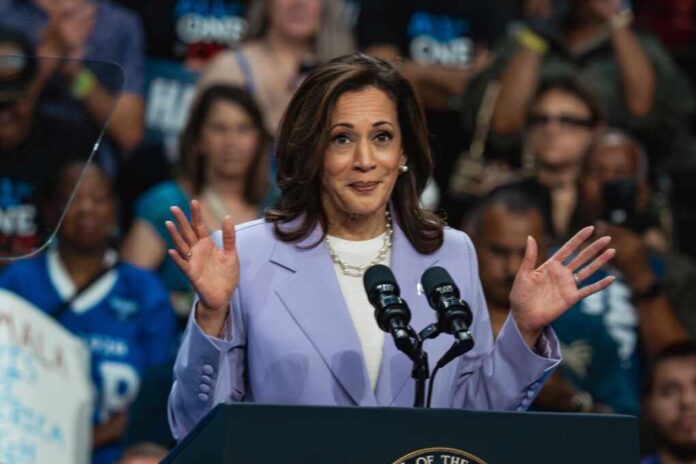
Vice President Kamala Harris’s decision not to publicly question President Joe Biden’s capacity for office, even amid growing debate over his fitness, has reignited discussion over transparency and accountability within the executive branch.
Story Snapshot
- BBC journalist directly confronted Vice President Harris on her silence about President Biden’s fitness during a high-profile interview.
- Harris’s evasive answers have fueled public frustration and renewed scrutiny of Democratic leadership.
- The episode highlights ongoing tension between political loyalty and responsibility to the American public.
- Media and political analysts debate the implications for future standards of executive branch accountability.
Direct International Scrutiny on U.S. Leadership
In late October 2025, the BBC aired a pointed interview with Kamala Harris, Vice President under the now-departed Biden administration, focusing on her decision not to raise concerns about President Biden’s capacity to serve. The line of questioning came after months of heightened scrutiny over Biden’s age and cognitive health—topics that had dominated both American and international headlines. The BBC’s direct approach underscored growing international interest in U.S. leadership stability and transparency, placing American political figures under a global microscope.
Harris’s responses during the interview did not directly address the questions raised by critics. When asked about her perspective on Biden’s capacity, Harris declined to offer a personal assessment and instead reiterated her support for the president. Some commentators observed that her answers left questions about accountability unresolved, particularly as confidence in the prior administration’s transparency had already waned among sections of the public. Political observers from outlets such as The Hill and Reuters noted that the exchange illustrated the challenges public officials face when balancing loyalty and honesty under media scrutiny.
Political Loyalty Versus Public Responsibility
The Harris interview took place amid continuing fallout from the 2024 election and broader debates about succession planning and trust in government. Historically, vice presidents have faced a difficult balancing act between supporting the president and independently addressing concerns about fitness or capacity. In this case, Harris’s reluctance to comment was viewed by some critics as prioritizing political loyalty over public disclosure—an interpretation that reignited discussion about transparency in executive leadership.
Analysts such as Larry Sabato of the University of Virginia Center for Politics note that the episode reflects a historical pattern: vice presidents rarely contradict their presidents publicly, even in periods of uncertainty. Others, including governance expert Elaine Kamarck at the Brookings Institution, argue that in a climate of public skepticism, more openness might have strengthened institutional trust. The interview, therefore, has become a case study in the tension between political allegiance and the public’s expectation of candor from elected officials.
Broader Implications for American Governance and Media
The BBC’s direct questioning has been cited by journalism observers, including the Poynter Institute, as an example of how international media can hold powerful figures accountable when domestic outlets appear less adversarial. The interview also highlighted the increasing role of non-U.S. media in shaping American political discourse, particularly in moments of leadership transition. This development underscores the value of rigorous questioning and transparency across all press environments.
Kamala Harris grilled by BBC journalist on why she didn't raise concerns about Biden's capacity #KamalaHarris #JoeBiden #Presidentialelectionhttps://t.co/rn15uHevlu
— Jesse Parris Aka Che Nkrumah (@JesseParris5280) October 27, 2025
In the immediate aftermath, both U.S. and international commentary focused on the responsibilities of vice presidents to speak openly about presidential capacity, especially during periods of uncertainty. The Harris-BBC exchange has prompted renewed discussion about expectations for those in the line of succession, with analysts suggesting that future leaders may face stronger pressure to address such issues directly. As the Trump administration works to restore confidence in American leadership, conservative commentators such as Ben Shapiro and outlets like The Daily Wire have argued that this episode underscores the need for clarity and accountability in future administrations. The broader lesson, they contend, is that loyalty should not eclipse the duty to ensure public confidence in national leadership.
Sources:
Kamala Harris Grilled by BBC Journalist on Why She Didn’t Raise Concerns About Biden’s Capacity
Kamala Harris Grilled by BBC Journalist on Why She Didn’t Raise Concerns About Biden’s Capacity