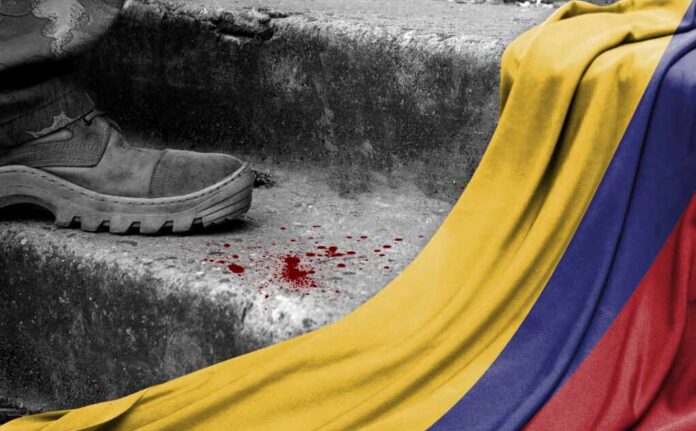
Thousands of Colombian combat veterans are being funneled into Ukraine’s brutal war zones through deceptive recruitment pipelines that exploit economic desperation, raising serious concerns about human trafficking and the weaponization of South America’s military talent by foreign powers.
Story Snapshot
- Approximately 2,000 Colombian ex-soldiers now fight in Ukraine, lured by salaries up to ten times their domestic wages through social media recruitment schemes
- President Petro’s military purges forced over 22,000 veterans into early retirement, creating a massive pool of combat-trained but unemployed fighters vulnerable to exploitation
- Russia has captured and sentenced multiple Colombian fighters to 19-year prison terms, denying them prisoner-of-war protections under Geneva Conventions
- Ukrainian intelligence exposed Colombian mercenaries in Russian brigades ordering civilian killings, implicating South Americans in war crimes
- Colombia’s mercenary ban remains largely unenforceable as private firms and Venezuela-linked transit routes continue operating with impunity
Petro’s Military Purge Creates Mercenary Supply Chain
Colombia’s leftist President Gustavo Petro inherited over 22,000 combat veterans when he took office in 2022, but his systematic purge of military leadership triggered mass voluntary retirements among demoralized forces. These ex-soldiers, trained exclusively for warfare during Colombia’s six-decade civil conflict, received inadequate pensions ranging from just 270 to 540 euros monthly with zero civilian reintegration support. Facing unemployment and possessing only combat skills, thousands became prime targets for foreign recruiters offering 1,500 to 3,000 euros monthly—a life-changing wage disparity that private firms and social media networks ruthlessly exploit to funnel fighters into Ukraine’s grinding attrition war.
Deceptive Recruitment Networks Exploit Desperation
Colombian veterans are being recruited through sophisticated deception operations mirroring earlier pipelines to Sudan’s civil war, where private security firms promised guard duty but delivered frontline combat roles. Social media platforms serve as primary recruitment tools, with operators targeting unemployed ex-soldiers through Facebook groups and messaging apps. Security researcher Jaramillo Macias notes the pipeline lacks reliable tracking, with claims of 4,000 Colombian mercenaries globally remaining unverified. Ex-sergeant José Angel Espinosa described feeling “held captive” by deceptive contracts that misrepresented combat expectations. Venezuela has emerged as a suspected transit hub and abduction point, with Alexander Ante and José Medina disappearing in Caracas in July 2024 while returning home from Ukraine, later surfacing in Russian custody.
Russia Weaponizes Captures for Propaganda Advantage
Russia’s treatment of Colombian fighters exposes the deadly consequences of this pipeline. On December 24, 2025, a Russian-backed Donetsk court sentenced Oscar Mauricio Blanco Lopez to 19 years for serving in Ukraine’s forces, denying him prisoner-of-war status under Geneva Conventions by classifying him as a mercenary. Moscow has prosecuted multiple Colombians with sentences up to 15 years, using trials as propaganda to portray Ukraine as reliant on foreign soldiers-for-hire. Ukrainian intelligence countered in October 2024 by releasing intercepted audio of a Colombian commander in Russia’s 30th Motorized Rifle Brigade ordering troops to kill women and children near Pokrovsk. This revelation implicates South American fighters in Russian war crimes, a development Ukraine’s HUR intelligence service characterized as command-driven atrocities designed to taint all foreign combatants.
Colombia’s Ban Proves Toothless Against Pipeline
President Petro’s government officially banned mercenary activity and launched investigations into recruitment networks, yet enforcement remains virtually nonexistent. Colombia’s Foreign Ministry has confirmed at least 50 Colombian deaths in Ukraine but lacks mechanisms to track demobilized personnel once they leave the country. Congressional efforts to ratify stricter anti-mercenary legislation have stalled, while active recruitment continues openly on social media platforms. Analyst Katherin Galindo observed that Petro’s clashes with military leadership directly fueled the mercenary supply by creating resentment and economic hardship among experienced soldiers. Venezuela’s suspected role as a transit hub further complicates enforcement, as Caracas maintains close ties with Moscow following Maduro’s disputed July 2024 re-election, straining Colombia’s ability to monitor or intercept fighters traveling through Venezuelan territory.
Colombian Mercenary Pipeline Funnels South American Fighters To Ukraine's Frontlines https://t.co/P0eF93ZJq6
— TYLΞR 🏴☠️ (@anonymous_ib) February 1, 2026
American Concerns Over Proxy War Expansion
This pipeline represents a dangerous precedent for proxy warfare that should alarm Americans watching the Trump administration navigate international conflicts. The exploitation of economically vulnerable veterans from allied hemispheric nations to fight European wars demonstrates how leftist policies—like Petro’s military purges and inadequate veteran support—create security vacuums that hostile powers fill. Russia’s denial of Geneva Convention protections to foreign fighters establishes a troubling standard that could endanger American personnel in future conflicts. Furthermore, the same networks funneling Colombians to Ukraine have ties to earlier Sudan operations linked to UAE interests, suggesting transnational mercenary infrastructure that operates beyond any single nation’s control. Ukrainian intelligence briefed the U.S. Congress in September 2025 on foreign fighter patterns, recognizing the strategic implications of this unregulated military labor market for Western security interests and the rule of law.
Sources:
Ukraine releases intercept of Colombian mercenaries ordered to kill women and children
Two Colombians who fought in Ukraine will be tried in Moscow on mercenary charges
Sudan, Ukraine: Why Colombian mercenaries keep fighting foreign wars
Why Are Colombians Fighting In The Russia-Ukraine War?
Russian-Backed Donetsk Court Sentences Colombian to 19 Years for Fighting for Ukraine
Ukraine recruiting Colombians despite mercenary ban move