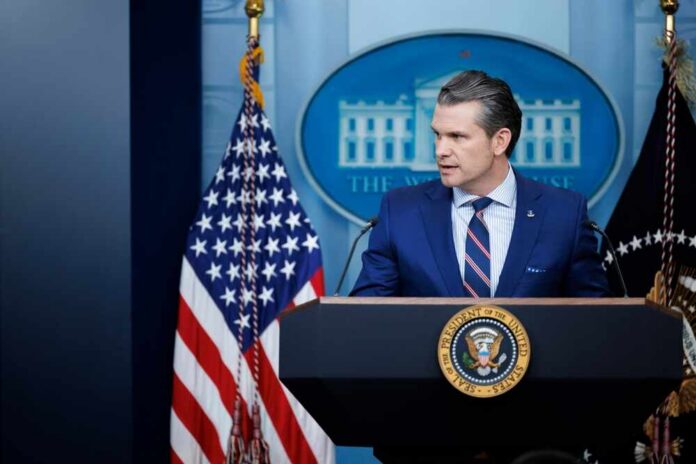
Pete Hegseth’s Pentagon prayer—reportedly lifted in part from Pulp Fiction—is reigniting a volatile question: should America’s wars ever be wrapped in the language of God?
Quick Take
- Defense Secretary Pete Hegseth led an April 15, 2026 Pentagon worship service using a prayer that echoed the famous Pulp Fiction monologue tied to Ezekiel 25:17.
- The prayer was linked to a Combat Search and Rescue mission (“Sandy 1”) that recovered two downed U.S. Air Force crew members over Iran, according to coverage.
- Critics argue the blending of pop culture, scripture, and war rhetoric risks politicizing faith and pressuring military culture in one direction.
- A reported papal rebuke the next day amplified the global controversy over using religion to justify war.
A Pentagon worship service collides with Hollywood and a hot war
Pete Hegseth led a Pentagon worship service on April 15, 2026, where multiple reports say he recited a prayer that closely mirrored the “Ezekiel 25:17” monologue popularized by Samuel L. Jackson in Pulp Fiction. The coverage describes Hegseth’s wording as blending biblical language with the movie’s stylized lines about “vengeance” and being “beset on all sides,” while tying the message to the ongoing U.S. conflict with Iran.
According to the reporting, the prayer was connected to a real operational backdrop: a Combat Search and Rescue effort known as “Sandy 1,” launched to recover two U.S. Air Force crew members who were shot down over Iran. Accounts say the prayer—circulated to Hegseth by the mission’s lead planner—was used as a kind of spiritual framing for the rescue and the broader campaign. That factual context matters, because it separates theatrical language from the life-and-death reality of wartime decision-making.
Why the “Pulp Fiction” angle matters more than a meme
The controversy is not simply that a cabinet official referenced a famous movie. The central dispute is whether government power—especially military power—should borrow the emotional authority of religion to validate violence, even indirectly. The reporting emphasizes that Pulp Fiction popularized a version of Ezekiel 25:17 that is not a straightforward Bible quotation, creating a perception problem: a prayer can sound “scriptural” while communicating something closer to a cinematic threat than a traditional liturgy.
Faith in public life versus faith as a tool of the state
Supporters of a strong public role for faith often argue that leaders have every right to speak openly about God, prayer, and moral clarity—especially when troops are risking their lives. Critics in the cited coverage argue something narrower and more institutional: that Pentagon worship services led by senior civilian leadership can blur the line between personal faith and an implicit expectation inside a command structure. In that setting, religious messaging can feel less voluntary, even when participation is technically optional.
Competing narratives: morale-building tradition or dangerous politicization
The same set of facts can feed two narratives. One narrative is morale and meaning: a rescue mission succeeds, leaders acknowledge providence, and prayer becomes a way to honor service members and families. Another narrative is politicization: the reporting describes Hegseth linking prayer to “policy and military decisions,” which critics read as a move toward faith-coded decision-making rather than constitutional, civilian-guided strategy. The sources do not provide evidence that policy was decided inside the service, but the optics are now part of the story.
What to watch next as the Iran conflict continues
As of April 16, 2026, the coverage focuses on the April 15 service and the backlash, including a reported statement from Pope Leo XIV condemning the use of religion to justify war. Beyond the headlines, the unresolved issue is governance: Americans across the political spectrum distrust institutions that seem self-protective, ideological, or performative. When Washington uses sacred language in a war context, it can deepen suspicion—among conservatives wary of elite manipulation and among liberals wary of religious nationalism—unless leaders clearly separate faith, policy, and accountability.
Limited public detail in the cited reporting leaves key questions unanswered, including how these Pentagon worship services are structured, what guidance exists to protect religious liberty for all personnel, and how war authorities are being debated in Congress. Those gaps will likely drive the next round of scrutiny. If the administration wants to avoid a “holy war” narrative—fair or not—it will need transparency: what was prayer, what was policy, and where constitutional oversight actually happened.
Sources:
Pete Hegseth quotes fake Pulp Fiction Bible verse during …
Defense Secretary Pete Hegseth quoted a monologue from …
Hegseth’s Pentagon prayer sounds like ‘Pulp Fiction’ line