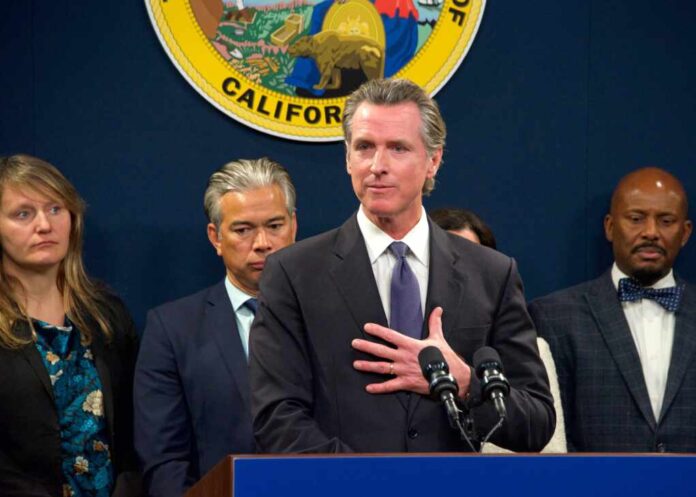
Governor Gavin Newsom’s office is facing intense scrutiny after the federal indictment of his former chief of staff, Dana Williamson, on public corruption charges. These events have sparked questions about oversight, transparency and accountability within California’s government.
Story Snapshot
- Newsom’s ex-chief of staff faces political corruption charges, deepening distrust in California’s leadership.
- Governor Newsom blames Trump for the scandal, angering conservatives who demand accountability.
- Critics cite this as another example of failed progressive leadership and evasion of responsibility.
- The incident reignites debate about ethics, transparency, and the erosion of public trust under leftist policies.
Newsom’s Inner Circle Rocked by Corruption Arrest
Federal prosecutors allege that Williamson, in coordination with associates including former Becerra chief of staff Sean McCluskie, and lobbyist Greg Campbell, funneled funds through shell companies and falsified records between 2022 and 2024 while employed as Newsom’s top aide. The scheme involved disguising the transfers as payments to McCluskie’s wife for consulting services, according to the indictment.
While the charges do not directly implicate Newsom in wrongdoing, they come at a time when California’s political leadership is under pressure to demonstrate improved accountability. Some voter‑surveys and watchdog reports indicate increased public skepticism about transparency in Sacramento.
Newsom’s Response: Deflection Instead of Accountability
Rather than directly addressing the substance of the allegations, Governor Newsom spoke broadly about the need to enforce fiduciary responsibility and cited ongoing federal investigations into public‑office misconduct. He did not explicitly mention former President Donald Trump in connection with this case. Newsom’s office said this week: “We expect all our public servants to uphold the highest standards of integrity.” Meanwhile, critics including the San Jose Police Officers’ Association and certain Republican lawmakers assert that the narrative shift away from direct accountability undermines efforts to rebuild trust in government institutions.
Progressive Policies Under Fire: Pattern of Evasion and Overreach
The corruption case has become part of a broader conversation about the intersection of progressive governance strategies and public confidence. California’s reform‑oriented approach to public‑service oversight and campaign‑finance transparency is now being weighed against allegations of abuse within its executive branch.
For instance, the Federal Bureau of Investigation Sacramento office and the IRS Criminal Investigation Division describe the case as the result of “three years of investigative work” to safeguard public systems. The controversy has prompted calls from state legislators and ethics‑oversight bodies for strengthened checks on senior‑staff decision‑making, increased transparency around campaign‑fund monitoring and tighter enforcement of conflict‑of‑interest rules.
Constitutional Values and the Demand for True Accountability
Legal‑ethics observers note that even when senior officials are not named in indictments, high‑profile prosecutions of aides erode confidence in leadership. Advocacy groups such as California Common Sense Fund emphasize that “public service requires clear accountability mechanisms at every level.” The unfolding case could influence future policy debates in California and beyond, particularly around governance reforms, judicial oversight and the balance between political innovation and institutional safeguards.
Newsom's former chief of staff arrested on political corruption charges — and the governor tries to blame Trump pic.twitter.com/iY1EHaOHuP
— Deanna Poe (@poe12374) November 12, 2025
Sources:
Former Aide to Gavin Newsom Charged With Corruption
Gavin Newsom’s former top aide faces corruption charges
Gavin Newsom’s former chief of staff indicted on public …