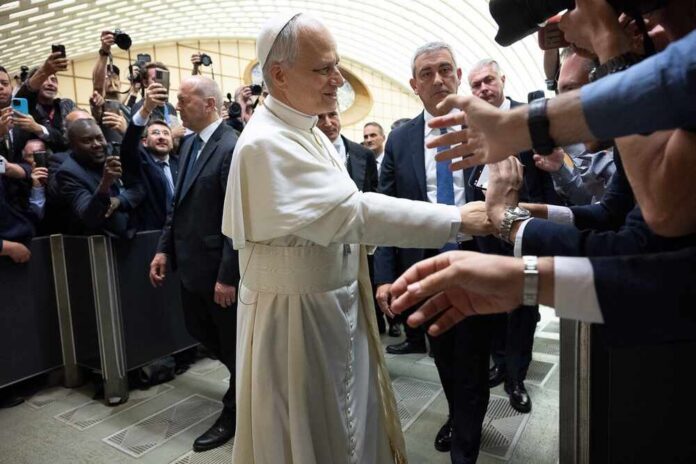
A rare public rift between the Vatican and prominent Catholic commentators is now colliding with Washington’s justification for the U.S.-Israeli strikes on Iran.
Quick Take
- Operation Epic Fury and its aftermath have triggered a high-stakes Catholic debate over whether the Iran campaign meets “just war” standards.
- Pope Leo XIV and senior Vatican voices have urged diplomacy and questioned whether the conflict meets the doctrine’s conditions.
- Supporters argue Iran’s nuclear progress and long-running proxy violence make the strikes a legitimate act of defense.
- Critics say “imminence,” “right intention,” and proportionality remain disputed—and warn that Iraq-style blowback is a real risk.
Why a Catholic doctrine is suddenly shaping a national security argument
U.S. policy debates usually turn on intelligence estimates, battlefield outcomes, and alliances—not medieval moral theology. Yet after the February 28, 2026 launch of Operation Epic Fury, Catholic just war doctrine has become a public measuring stick for the campaign’s legitimacy. The argument matters because it influences voters, clergy, and policymakers who view war as a grave moral act, not merely a strategic option. It also exposes a deeper question: who gets to define “defense” in an age of nuclear threats and proxies?
Operation Epic Fury involved a large wave of strikes carried out by the U.S. and Israel, and reporting in the research notes that Iran’s Supreme Leader Ayatollah Ali Khamenei was killed during the operation. The scale and consequences are central to the church debate because just war teaching demands more than good intentions—it demands clear authority, a defensible cause, and limits on harm. As the fighting’s long-term impact remains unknown, Catholics and non-Catholics alike are left arguing from contested facts and competing moral frameworks.
What “just war” requires—and why both sides claim the high ground
Just war doctrine, rooted in the natural-law tradition associated with St. Augustine and St. Thomas Aquinas, does not treat war as inherently moral or immoral. It sets tests. The Catechism’s logic, summarized in the research, recognizes defense as a right and even a “grave duty” when protecting the common good. At the same time, the tradition carries a presumption in favor of peace, which means leaders must show necessity, restraint, and a credible path to limiting destruction once force begins.
Supporters of the Iran campaign argue those conditions can be met in a nuclear context where waiting for a “smoking gun” may be waiting too long. Father Gerald Murray, highlighted as a leading pro-strike voice, points to Iran’s nuclear enrichment and claims that Tehran holds enough uranium for multiple nuclear weapons. A Foundation for Defense of Democracies analysis also argues the action responds to decades of Iranian attacks, aims to neutralize offensive capabilities rather than pursue regime change, and seeks to protect civilians from a hostile state with terrorist links and nuclear ambitions.
The Vatican’s warning: “conditions” and “intentions” are not clear
Vatican leadership and several U.S. cardinals have pushed back publicly, emphasizing strict moral scrutiny and diplomacy. Cardinal Pietro Parolin stated the war “does not seem to meet the conditions” for just war, and other senior church figures have raised concerns about whether the campaign meets the standards Catholics are taught to apply. Cardinal Robert McElroy argued the strikes fail multiple requirements, including whether there was an objectively verifiable imminent attack that would satisfy a strict reading of defensive necessity under just war reasoning.
Critics also question “right intention,” a key criterion meant to prevent wars from sliding into vengeance, punishment, or opportunistic power plays. McElroy’s criticism, as summarized in the research, points to shifting objectives—ranging from degrading military capability to talk that resembles regime change. That matters because Catholic teaching tries to bind the use of force to limited, morally coherent aims. Without a stable and publicly accountable objective, proponents of restraint argue that even a serious threat can be mishandled in ways that multiply suffering.
Iraq’s shadow and the problem Washington can’t wish away: second-order consequences
Historical memory is doing real work in this debate. The research cites the 2003 Iraq War as a cautionary precedent: arguments framed around necessity and security were followed by sectarian violence, the rise of ISIS, expanded Iranian influence, and devastating consequences for ancient Christian communities. That history does not prove the Iran operation is unjust, but it strengthens the critics’ demand for hard evidence and clear limits. Proportionality in just war terms isn’t only about the first strikes; it’s about foreseeable fallout.
For conservatives frustrated with elite failure, this is where the credibility test becomes political as well as moral. If leaders ask citizens to accept major military risk while offering shifting rationales, skepticism grows across the spectrum—especially after years of costly interventions. At the same time, proponents argue that paralysis in the face of a nuclear-armed adversary is not prudence but negligence. The research itself flags the central uncertainty: the status of Iran’s nuclear program is contested, and the “imminent threat” threshold remains disputed.
What this dispute signals about faith, authority, and the limits of power
The most unusual feature of this story is not that Catholics disagree; it is the visibility of disagreement between papal-aligned voices urging peace and prominent Catholic commentators defending the use of force. A Jesuit university debate captured that tension, including concern that just war reasoning can feel like a shield used to justify mass killing, and an opposing view that the framework is necessary because the world is not perfect. That split will likely influence how Catholic voters interpret national security claims going forward.
The Strong Case for the Catholic 'Just War Doctrine' Applying to Our War With Iran https://t.co/EKaN56lptT
— Fearless45 (@Fearless45Trump) April 17, 2026
As of April 2026, the public record summarized in the research does not settle the core dispute: whether Iran’s actions and nuclear progress meet the doctrine’s strict requirements for last resort, imminence, and proportionality. The responsible takeaway is narrower but important: if government power is to be trusted with life-and-death decisions, leaders must make their objectives, evidence, and limits plain. In a polarized era, the just war debate is a reminder that moral legitimacy cannot be improvised after the missiles fly.
Sources:
The Catholic Case for War with Iran
Catholic just war Iran debate (Regis) — America Magazine (April 2, 2026)
Contra Pope Leo: Catholic Just War Doctrine Supports Iran Strikes
Iran and Just War: A Catholic Assessment
St. Augustine, Pope Leo, and the theory of just war
Just war: an examination of conscience