Campus “free speech” culture hit a breaking point when protesters shut down Hillary Clinton’s Columbia appearance—forcing a blunt reminder that protest rights don’t include commandeering the microphone.
Quick Take
- Hillary Clinton’s Columbia University speech was repeatedly interrupted by pro-Palestinian protesters accusing her of war crimes tied to past U.S. foreign policy.
- Clinton paused the program and drew a firm line between lawful protest and disruption that blocks others from speaking.
- Columbia officials removed multiple disruptors as the event resumed, highlighting a recurring campus governance challenge since October 2023.
- Available reporting shows no major follow-up actions through February 2026, suggesting the incident became more symbol than turning point.
Disruption at Columbia Put the “Protest vs. Proceed” Question on Stage
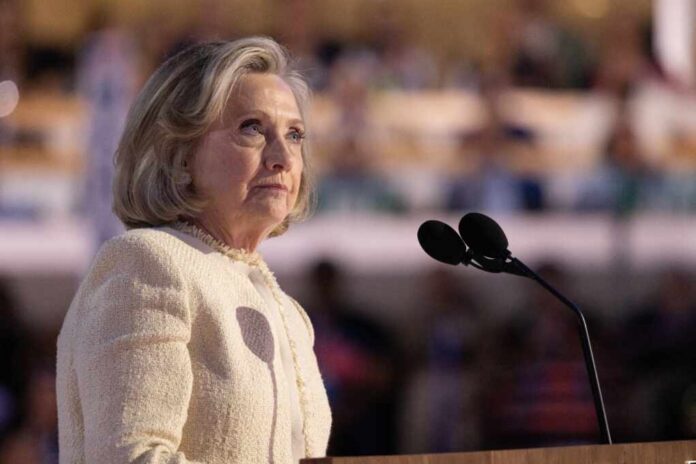
Hillary Clinton was speaking at Columbia University in October 2023 when a series of pro-Palestinian protesters interrupted her event with shouted accusations connected to her time as Secretary of State. According to contemporaneous coverage, a protester called her a “war criminal” and listed countries linked to U.S. policy disputes, while others chanted “Free, free Palestine.” Columbia officials removed disruptors, but additional interruptions followed before the program could continue.
Clinton’s response, as reported and captured on video, focused less on the substance of the accusations and more on the conduct inside the room. She halted the event to address the crowd and attempted to reassert a basic rule of civil discourse: people can protest, but they cannot prevent others from speaking or derail scheduled panelists. The moment became a snapshot of the modern campus dilemma—administrators promising openness while struggling to keep events functional.
Clinton’s On-Record Standard: Protest Is Allowed, Disruption Is Not
Clinton told the room that yelling “doesn’t solve the problem” and emphasized that participants are free to protest but not free to disrupt events. She also tried to protect the rest of the program by pausing and effectively inviting the disruptors to get their interruptions out at once so panelists could speak without being shouted over. That distinction matters in any constitutional society: the First Amendment protects speech, but it does not guarantee a right to hijack private or organized forums.
The setting amplified the stakes. Clinton is tied to the university as chair of the Columbia Center for Global Policy, and the event was hosted at Columbia’s School of International and Public Affairs. SIPA dean Keren Yarhi-Milo intervened during the disruption, reflecting an institutional choice to enforce order rather than allow an open-ended heckler veto. For viewers frustrated by disorder on elite campuses, the episode underscored how quickly “activism” can turn into a tactic to silence.
Why Columbia Became a Flashpoint After October 7, 2023
The protest wave did not appear in a vacuum. Reporting tied the Columbia incident to intensified campus activism after the October 7, 2023 Hamas attack on Israel and Israel’s military response in Gaza. Columbia, in particular, became a recurring stage for conflict over demonstrations, group discipline, and who controls public space on campus. In that environment, high-profile figures like Clinton functioned as symbolic targets for activists seeking maximum attention.
Protesters explicitly linked their claims to U.S. policy choices during the Obama-era period when Clinton served as Secretary of State, pointing to controversies involving Libya, Iraq, Syria, Yemen, and Palestine. The available material does not provide adjudicated findings about the protesters’ “war crimes” accusations; instead, it documents the fact that the accusations were shouted and that the event’s immediate dispute was over disruption. That gap matters for readers trying to separate provable claims from slogans.
Limited New Developments Since 2023, but the Institutional Lesson Lingers
By February 2026, the provided research indicates no significant follow-up actions such as lawsuits, formal policy changes, or a documented chain of repeat incidents stemming directly from this specific speech. The incident appears to have remained largely an isolated confrontation captured in media coverage rather than a clear catalyst for reform. Even so, the broader issue—whether campuses enforce viewpoint-neutral rules that allow speakers to finish—continues to shape how Americans judge higher education’s seriousness.
For conservatives who watched years of institutions bend to the loudest activists, the most concrete takeaway is procedural: when disruption becomes tolerated, the practical freedom to speak belongs to whoever can shout the longest. Clinton’s own line—protest is allowed, disruption is not—reflects a principle that should apply regardless of ideology. The Constitution protects debate, but it doesn’t require schools to surrender every event to coordinated interruption, especially when invited experts and attendees are denied their turn.
Sources:
WATCH: Hillary Clinton speech repeatedly interrupted by pro-Palestinian protesters
Hillary Clinton email controversy