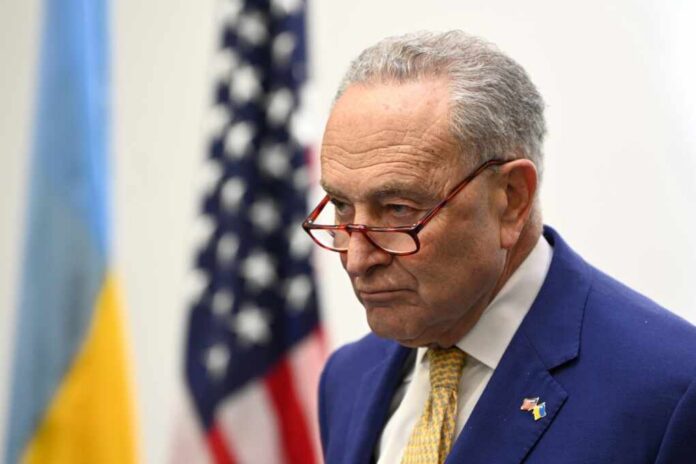
Senate Minority Leader Chuck Schumer ignited a firestorm by comparing common-sense voter ID legislation to Jim Crow-era racial discrimination, exposing the Democrats’ desperate opposition to election integrity measures.
Story Snapshot
- Schumer denounced the SAVE Act as “Jim Crow 2.0,” claiming voter ID requirements constitute voter suppression
- House Republicans attached the voter verification bill to government funding legislation, creating a legislative standoff
- Senate Democrats vowed to block any legislation containing the SAVE Act, threatening government operations
- Republican lawmakers blasted Schumer’s inflammatory rhetoric, defending voter ID as legitimate election security
Schumer’s Inflammatory Jim Crow Comparison
Senate Minority Leader Chuck Schumer escalated partisan tensions by characterizing the Safeguarding American Voter Eligibility Act as “Jim Crow 2.0” during Senate floor remarks. The New York Democrat declared the legislation “dead on arrival in the Senate” and labeled it a “poison pill” that would kill any bill it touches. Schumer claimed the SAVE Act has “nothing to do with protecting our elections and everything to do with federalizing voter suppression,” invoking the dark history of post-Reconstruction laws that disenfranchised Black voters through literacy tests and poll taxes.
Schumer’s rhetoric reveals a broader Democratic strategy to demonize election security measures that most Americans support. He alleged the legislation would eliminate online voter registration, mail registration, and registration drives while creating “massive purges” of legitimate voters. The Senate Minority Leader warned that 50 percent of Americans lack passports and many cannot access birth certificates, claiming these citizens would be disenfranchised. His hyperbolic comparison trivializes actual historical injustices while obscuring the simple fact that the SAVE Act merely requires proof of citizenship to vote in federal elections.
Republican Defense of Election Integrity
House Republicans pushed back forcefully against Schumer’s accusations, defending the SAVE Act as essential election security legislation. Representative Anna Paulina Luna of Florida countered that minority voters supporting voter ID requirements are not endorsing racist policies, directly challenging Schumer’s inflammatory characterization. Representative Eric Burlison of Missouri declared that “no spending package should come out of the House without the SAVE Act attached,” emphasizing that securing American elections represents a non-negotiable priority for conservatives who watched irregularities undermine public confidence in recent election cycles.
The SAVE Act addresses legitimate concerns about election integrity by requiring photo identification and proof of citizenship for voter registration. Federal law already prohibits non-citizen voting, but enforcement mechanisms remain inadequate without proper verification systems. House Republicans strategically attached the legislation to government funding negotiations, seeking concrete victories on election security after years of Democratic obstruction. Senate Republicans including Rick Scott of Florida and Mike Lee of Utah co-sponsored the updated legislation, demonstrating broad conservative support for measures that ensure only eligible American citizens participate in federal elections.
Democrats’ Unified Opposition Strategy
Senate Democrats adopted a unified opposition strategy, with Schumer declaring that “every single Senate Democrat will vote against any bill” containing the SAVE Act. This lockstep resistance reveals Democratic priorities: maintaining current registration systems that lack robust citizenship verification rather than implementing common-sense safeguards. Democrats argue the legislation would disenfranchise 69 million Americans who changed names after marriage and those who recently moved, yet these claims ignore that proper identification verification protects election integrity without preventing legitimate voters from participating through reasonable compliance processes.
The Democratic position hinges on the Senate’s 60-vote threshold, giving them effective veto power despite Republican control of the House. Schumer’s inflammatory rhetoric serves a political purpose beyond the immediate legislative battle—painting voter ID requirements as racist suppression rather than fraud prevention frames the debate in emotional rather than practical terms. Democrats claim the SAVE Act would “slant elections away from free and fair” by targeting their voters, inadvertently acknowledging that stricter verification might affect their electoral prospects. This reveals the underlying concern: Democrats benefit from current registration systems that lack comprehensive citizenship verification.
Shutdown Politics and Funding Leverage
The SAVE Act controversy emerged during high-stakes government funding negotiations, with House Republicans leveraging must-pass legislation to advance election security priorities. President Trump initially negotiated a funding truce with Schumer that stripped controversial Department of Homeland Security spending in favor of a two-week extension. House Republicans subsequently modified this compromise by adding the SAVE Act, seeking tangible policy victories on core conservative priorities. This tactical approach acknowledges political reality: transformative legislation requires strategic pressure points, and government funding represents one of few leverage opportunities in divided government.
Chuck Schumer Lambasted After Comparing the SAVE Act to Jim Crow https://t.co/ke6ggJLoQL #gatewaypundit via @gatewaypundit
— thomas charlton (@thomascharlton1) February 4, 2026
Schumer accused Republicans of “pining for a shutdown” by including election integrity provisions, but conservatives understand that defending the Constitution’s guarantee of republican government requires actual citizens selecting representatives. The standoff creates what observers describe as “virtual ping-pong between the chambers,” with House passage forcing Senate reconsideration. House Speaker Mike Johnson faces pressure from members prioritizing election security alongside those concerned about prolonged shutdown consequences. This tension reflects broader conservative frustrations with establishment Republicans who too often surrender policy priorities to avoid Democratic media attacks and temporary government disruptions.
Sources:
Fox News – Schumer Nukes GOP Push for Voter ID Laws in Trump-Backed Shutdown Package
Senate Democrats – Leader Schumer Remarks Denouncing the Dangerous Republican SAVE Act
Congress.gov – H.R. 22 SAVE Act Bill Information