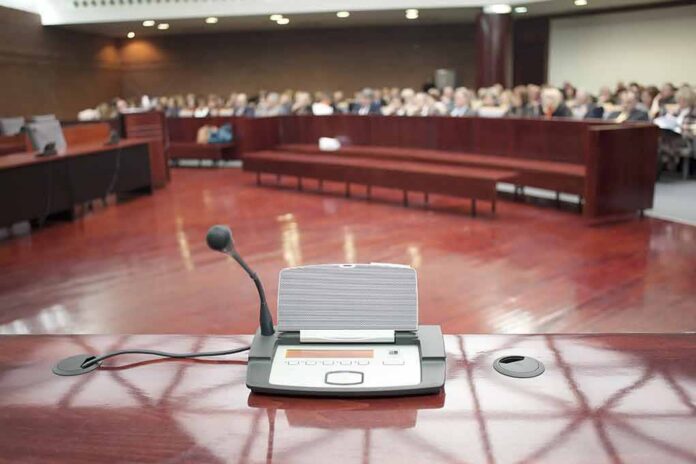
Two Supreme Court justices are heading to Capitol Hill to defend a sharply higher budget request for their own court, including a big jump in money for security and technology.
Story Snapshot
- Justices Elena Kagan and Amy Coney Barrett will testify before House and Senate panels on the Supreme Court’s budget request for fiscal year 2027.
- The Court is seeking roughly $210 million for salaries and expenses, plus related building funds, with outside estimates putting the total request near $225 million.
- The plan includes a $14.6 million boost for Supreme Court Police security around justices’ homes and families, part of a broader push to expand protection.
- This kind of in-person budget testimony by sitting justices was routine for decades but has become rare since 2011, raising fresh questions about oversight and independence.
Rare Supreme Court Appearance Comes Amid Bigger Fights Over Spending
Justices Elena Kagan and Amy Coney Barrett are set to testify before Congress on the Supreme Court’s fiscal year 2027 budget, in both a House Appropriations hearing and a Senate Appropriations Committee session. These hearings will unfold under President Donald Trump’s second-term budget blueprint, which pours money into defense while cutting many domestic programs. In that larger fight over federal priorities, the Court’s request looks small in dollars, but big in what it says about power, safety, and trust in the government.
The official judiciary budget documents say the Supreme Court wants $210.3 million for salaries and expenses in 2027, split between mandatory and discretionary funds. A separate congressional briefing from the Congressional Research Service puts the total discretionary request at $225.1 million when salaries, expenses, and building care are counted together. Media and advocacy summaries round this up to “about $225 million,” and describe the increase as roughly 29 percent over current levels. These different numbers confuse many people and feed doubts about how clearly Washington explains its spending.
Security Money Highlights Shared Fears About Safety And Power
The budget summary shows a $14.6 million increase tied directly to expanding the Supreme Court Police protective force, including more officers and support for guarding justices’ homes and families. That money would add dozens of full-time staff and continue a trend of rising security costs after high-profile protests and threats around recent court rulings. Supporters say this is basic protection for judges who now live under constant risk. Critics worry that security budgets everywhere grow without enough proof that dollars are used well or fairly.
The Supreme Court’s request lands at a time when many Americans on both the right and left believe the system protects leaders more than ordinary families. Conservatives upset about “woke” policies and crime see rising security as proof that elites insulate themselves while neighborhoods struggle. Liberals angry about money in politics and inequality see more guards for powerful judges as another sign that institutions serve the top first. The Court’s plan to bulk up security, even if justified by threats, will naturally be judged through that lens of growing distrust.
Technology Upgrades And Building Costs In An Era Of Cuts Elsewhere
The plan also asks for $1.5 million in no-year funding for court-wide technology and automation upgrades, meant to modernize systems over time rather than in one burst. That includes tools to manage case filings, internal communications, and possibly better public access to opinions and arguments. On paper, these are modest investments compared to the billions spent on military technology and federal data systems. Still, they come as the Trump administration pushes 10 percent cuts to many non-defense agencies, including health, housing, and social services.
For people watching their local schools, clinics, and energy help programs face cuts, even a relatively small increase for the Supreme Court can feel like part of a larger pattern: the core institutions of Washington continue to get what they ask for, while basic services for regular citizens are squeezed. The judiciary argues that technology upgrades help cases move faster and reduce errors, which should help everyone seeking justice. But with the American Dream already strained for many families, patience for any government office asking for more money is thin, no matter how noble the mission sounds.
Old Oversight Norm Returns As Trust In Institutions Falls
Legal scholars note that Supreme Court justices used to testify before Congress almost every year from the 1960s through 2011, taking part in more than ninety committee hearings. That practice largely stopped in the last decade, especially on the Senate side, as concerns grew about keeping a clear line between the judicial and legislative branches. The upcoming appearances by Kagan and Barrett mark the first Senate budget testimony by sitting justices since 2011 and the first House budget testimony by a justice since Kagan and Samuel Alito spoke in 2019.
Elena Kagan, Amy Coney Barrett to testify on Supreme Court budget request https://t.co/YzK4BBPvF3
— Unlikely Buddha (@Unlikely_Buddha) July 9, 2026
Supporters of these hearings say they improve transparency and give lawmakers a chance to ask hard questions about spending, ethics, and security. Skeptics worry that justices explaining their needs directly to politicians may blur the separation of powers, especially when the Court is already under fire for its decisions and internal ethics debates. For citizens who feel the “deep state” protects itself above all else, watching unelected judges come to Congress seeking more money could either look like overdue accountability or another insiders-only conversation that leaves regular people on the outside.
Sources:
youtube.com, uscourts.gov, facebook.com, appropriations.senate.gov, congress.gov, legis1.com, appropriations.house.gov, instagram.com, evrimagaci.org, stevevladeck.com