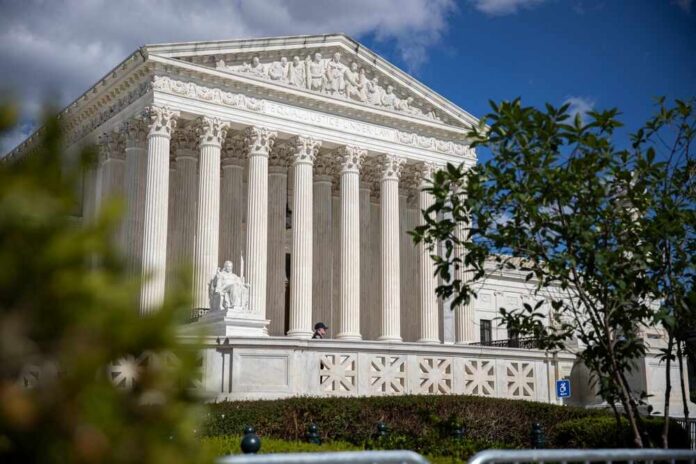
Virginia’s highest court just erased a Democrat-backed redistricting win after tens of millions in campaign spending—keeping a would-be 10–1 congressional map off the books.
Quick Take
- The Virginia Supreme Court struck down a voter-approved redistricting amendment and map in a 4–3 ruling, citing constitutional process problems.
- The voided plan would have reshaped Virginia’s 11 House districts into a heavily Democratic-leaning 10–1 split, according to political analysts who reviewed the proposal.
- Democratic-aligned groups spent more than $64 million promoting the effort, including major funding tied to House Democratic leadership.
- The decision keeps the existing post-2021 map in place for the 2026 election cycle, reshaping the national fight for House control.
A court ruling that changed the 2026 playing field overnight
Virginia’s Supreme Court ruled 4–3 in May 2026 to strike down a Democrat-backed constitutional amendment and the congressional map tied to it, even though voters had narrowly approved the plan in an April 21 special referendum. The court’s majority focused on procedure, finding the amendment process did not follow required steps under the state constitution. That conclusion effectively voided the new lines and restored the prior map for upcoming elections.
The political headline is bigger than one state. Virginia sends 11 members to the U.S. House, and control in Washington often turns on a handful of seats. Analysts had described the proposed lines as an aggressive attempt to lock in a dominant advantage for one party. With Republicans holding the federal government in 2026, the ruling also lands inside a broader national tug-of-war over institutional power: courts and constitutions acting as guardrails when legislatures try to rewrite the rules midstream.
How the amendment-and-map strategy ran into a constitutional wall
The legal vulnerability, based on available reporting, was not a dispute over whether politicians “always” seek advantage—both parties do—but whether the state’s constitution allowed this method and timing. The court said the process “irreparably” undermined referendum integrity by bypassing required steps for amendments, including legislative actions that should have happened before voters were asked to approve the change. That is a critical distinction for citizens who want clear, predictable rules, regardless of party.
Democrats argued, in essence, that voters had spoken and the court should have resolved any challenges before the election was held. That frustration resonates beyond the left: Americans across the spectrum are tired of feeling like big decisions get settled by process fights and legal maneuvering rather than transparent governance. Still, the practical lesson is hard to ignore. If lawmakers cut corners, courts can—and sometimes will—invalidate the end result, even after ballots are cast.
The money trail—and what it signals about national party priorities
Financially, the effort was enormous by state standards. Reporting cited more than $64 million in spending to sell the referendum and map, with roughly $40 million connected to a group tied to House Democratic Leader Hakeem Jeffries. Opponents were outspent by about 10 to 1 on advertising, yet still prevailed through the legal challenge. For voters already cynical about “elite” influence, the episode reinforces a familiar pattern: well-funded political machines can dominate airwaves without securing durable legitimacy.
That spending also illustrates how nationalized congressional politics has become. State-level district lines are treated like federal strategic assets, because they are. When donors and national committees pour money into shaping a state’s delegation, local voters can feel like an afterthought. From a conservative perspective, the court’s insistence on constitutional procedure acts as a check on that kind of top-down power play. From a liberal perspective, the ruling feels like a veto of voter intent.
Fallout: distrust, social-media warfare, and a map that stays put
Public reaction quickly turned into a proxy battle over legitimacy. House Democrats called the ruling “anti-democratic” and argued it disenfranchised voters who approved the referendum. Conservative commentators highlighted the scale of spending and mocked the outcome as a self-inflicted defeat. Separate from the redistricting case, reporting also noted an FBI raid connected to Virginia Senate Majority Leader L. Louise Lucas on an unrelated probe, adding to the perception—fair or not—of a political class under constant ethical clouds.
Heartbreak for Dems As VA Senate Majority Leader Delivers Crushing Blow to Latest Gerrymander Schemehttps://t.co/4lQ4g4pft7
— RedState (@RedState) May 11, 2026
For now, the immediate policy outcome is straightforward: the 2021-era congressional map remains in effect for 2026. That means the sweeping 10–1 reshuffle is off the table unless new litigation or a new, constitutionally compliant process emerges. The deeper takeaway is less technical and more cultural. Americans who believe government is drifting away from basic fairness see this as another sign that rules are bent until a court stops it—and that ordinary citizens are left watching institutions fight over power.
Sources:
Social media erupts after Democrats burned $64M on failed Virginia gerrymander