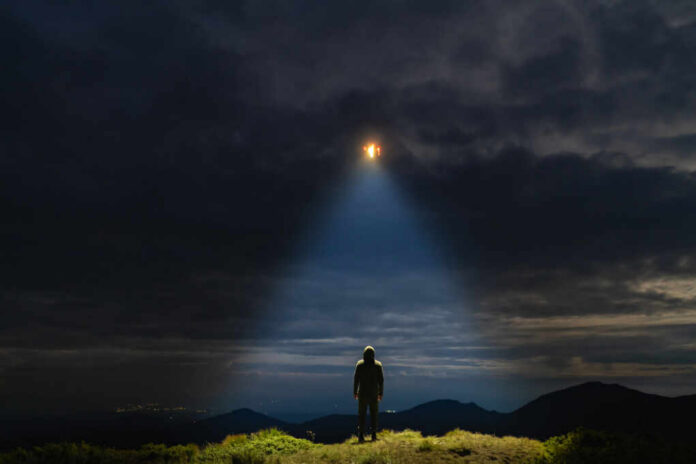
The Pentagon just put decades of “unresolved” UFO cases online—breaking a long-standing secrecy culture that has fueled public distrust for generations.
Quick Take
- The Department of War launched a new public portal, war.gov/UFO, and released an initial tranche of 162 declassified UAP files on May 8, 2026.
- The first drop includes 120 PDFs, 28 videos, and 14 images spanning decades, including military sightings and Apollo-era materials.
- Officials stressed the releases do not confirm extraterrestrial origins, framing the material as unresolved and open to public analysis.
- Some documents remain partially redacted, with the Pentagon citing protection of sensitive sources, methods, and locations.
A New Transparency Test for a Government Many Americans Don’t Trust
The Department of War posted the first “Release 01” set of Unidentified Anomalous Phenomena files on May 8, 2026, creating a centralized website at war.gov/UFO and promising additional tranches every few weeks. The initial batch totals 162 files, including 120 PDFs, 28 videos, and 14 images. The Pentagon described the cases as unresolved and invited independent review, an approach aimed at showing maximum transparency under President Trump’s directive.
Secretary of War Pete Hegseth publicly framed the move as overdue access for ordinary Americans, while NASA Administrator Jared Isaacman emphasized candid separation between what agencies know and what remains uncertain. That split matters: releasing raw material can reduce suspicion of a permanent “deep state” cover-up, but it can also trigger misinformation if viewers treat ambiguous clips as proof of aliens rather than as incomplete data collected for safety and security.
What’s Actually in the Files—and Why Redactions Still Matter
The documents cover a wide span of time and sources, including eyewitness accounts, military reports, and older FBI records from 1947 to 1968 that appear with fewer redactions than some earlier public versions. The Pentagon also included photos tied to Apollo missions and more recent military sightings from various regions, such as the Middle East and Europe. In total, officials said 108 files contain some redactions—an acknowledgment that transparency is being balanced against operational security.
Conservatives who have watched Washington overclassify everything from pandemic decisions to border metrics will likely focus on the redactions as the real tell. At the same time, not every blackout is automatically sinister. The Pentagon’s stated justification is protecting sensitive information, including sources, methods, and locations—exactly the kinds of details that can endanger service members or expose capabilities. The release creates a public record that can be scrutinized, but it does not erase legitimate national security constraints.
How We Got Here: From Stigma to Security—and Back to Public Pressure
Federal interest in UFOs dates back to the late 1940s, with formal investigations like Project Blue Book (1947–1969) and later Pentagon efforts that treated unusual objects as potential threats rather than pop-culture curiosities. In the 2000s, the Advanced Aviation Threat Identification Program (AATIP) reflected a shift toward assessing whether sightings could involve advanced foreign technology. That security framing accelerated after public Navy videos and years of congressional hearings about unresolved cases.
The 2026 release also lands in a political moment shaped by public frustration with institutions that often appear to protect themselves first. Former President Obama’s remarks earlier this year reignited attention before being walked back, and President Trump then announced plans to declassify UAP material. The Department of War now says it is reviewing “tens of millions” of records across more than 20 agencies, suggesting this first drop is less a conclusion than the beginning of a larger information fight.
What the Rollout Means Politically—and What It Doesn’t Prove
Politically, a rolling disclosure schedule serves two purposes at once. It gives the Trump administration a tangible transparency win while putting career bureaucracy under a spotlight that many voters believe it has avoided for decades. Substantively, the Pentagon and NASA are signaling caution: the cases are unresolved, not validated as extraterrestrial. That framing is important because a government can be both more open and still uncertain—especially when the underlying data is fragmentary and collected under stress.
Pentagon releases previously secret files on UFOshttps://t.co/qpWvR9gxTl
— Insider Paper (@TheInsiderPaper) May 8, 2026
The bigger issue for Americans across the spectrum is whether this model becomes normal: centralized disclosure, clear categorization, and a default posture of public access unless security truly requires secrecy. If future tranches arrive as promised—and if the public sees consistent standards for what gets released versus withheld—trust could improve incrementally. If the process turns into selective transparency or political theater, it will reinforce the same cynical conclusion many voters already share: the system protects itself first.
Sources:
Pentagon Begins Releasing New UFO Files
Pentagon Releases Swath of UFO Files